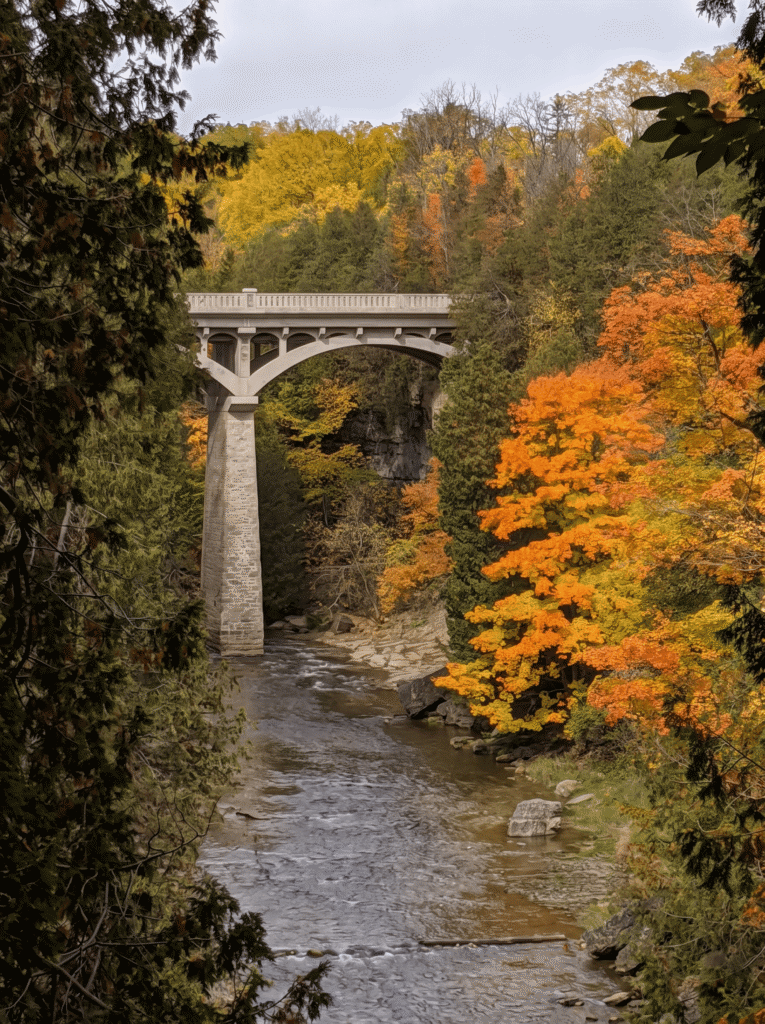
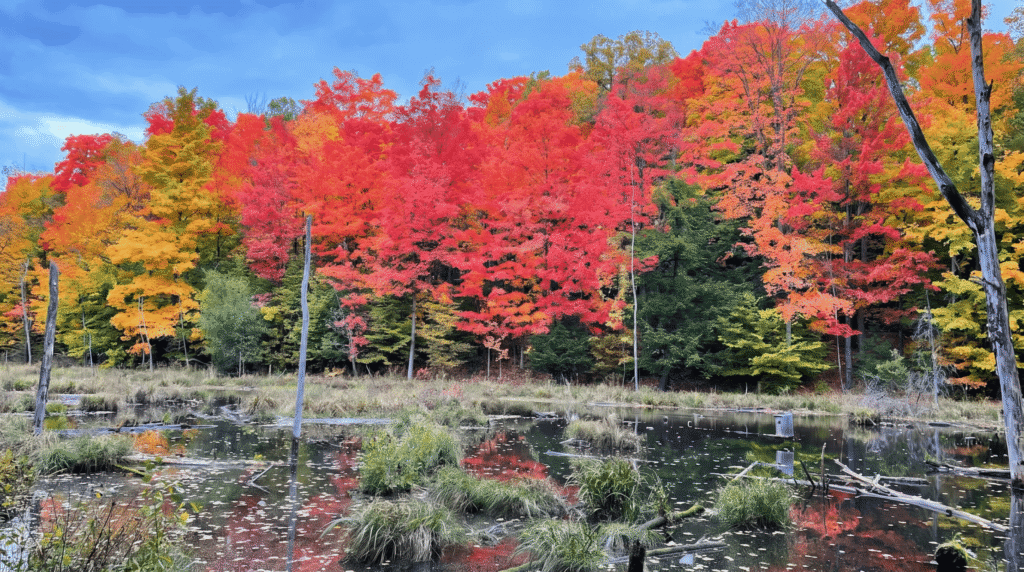
BEST FALL DAY TRIPS FROM TORONTO (BEFORE THE LEAVES ARE GONE)
Toronto fall is annoyingly brief. One minute you’re still ordering an iced coffee on Queen West, the next every tree looks perfect and you have approximately two weekends before the city starts discussing winter.
Which is exactly when you should leave it for a day.
Some of the best fall day trips from Toronto are close enough to do without turning the weekend into a logistical project: dramatic trails around the Niagara Escarpment, small towns beside rivers, winding roads through Caledon and vineyards that look particularly good once everything turns gold.
We narrowed it down to four very different fall days — because not everyone wants to spend Saturday hiking uphill for a view.
By CELESTE FERNER SEPTEMBER 3, 2026
WHEN TO ACTUALLY PLAN A FALL DAY TRIP FROM TORONTO
The slightly inconvenient thing about Ontario fall colours is that they do not care about your calendar.
Northern Ontario generally changes first, while Toronto and much of Southern Ontario follow later. In early September, the Ontario Parks fall-colour report can still show parks around the GTA almost entirely green; the progression then changes quickly depending on temperatures, rainfall and wind. Even locals regularly point out that the first weekend of October can be early for peak colour around Toronto.
So instead of automatically choosing Thanksgiving weekend every year, check the Ontario Parks Fall Colour Report a few days before you go. It tracks colour change and leaf fall at provincial parks around Ontario and is much more useful than an article promising that October 10 will magically be perfect everywhere.
There’s another reason to plan ahead: peak foliage brings peak crowds. Mono Cliffs now requires an advance daily vehicle permit to guarantee entry, while reservations are required at Spencer Gorge during the busiest fall period for Dundas Peak, Tew Falls and Webster Falls. The spontaneous fall road trip is still alive. It just occasionally needs a reservation first.
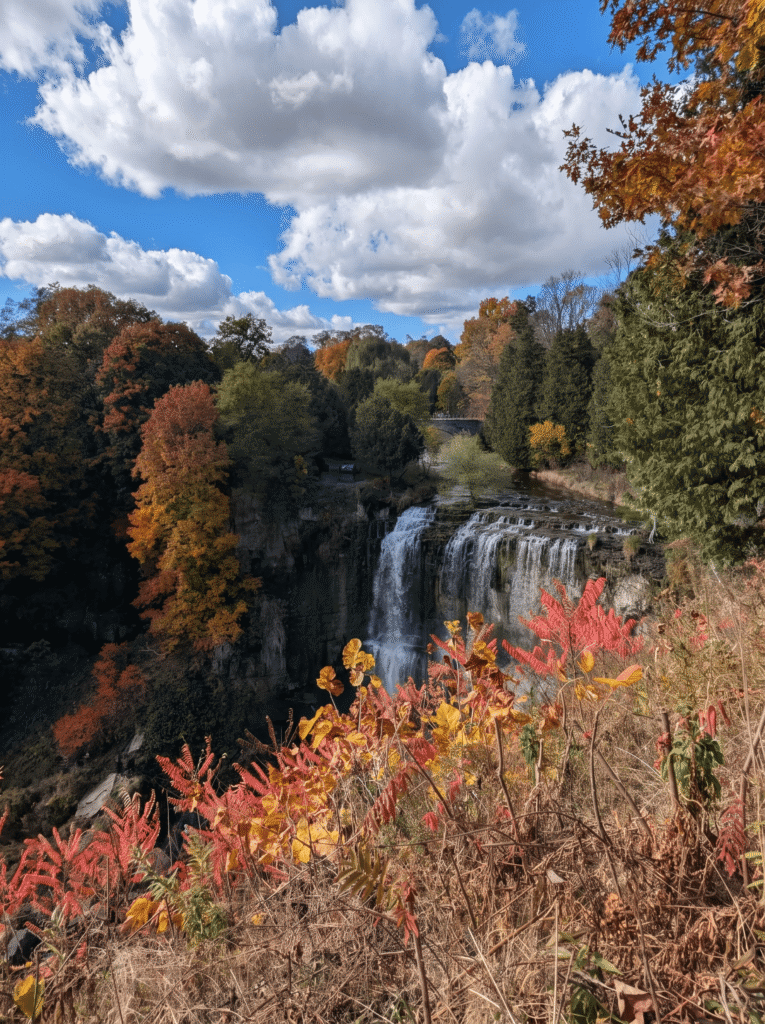
About 1.5 hours from Toronto, Elora is the fall day trip for when you want nature but also want lunch afterwards somewhere with actual walls.
The village sits along the Grand River and its famous gorge, with limestone cliffs, river views and walking paths surrounded by trees. Start around Victoria Park for views over the gorge, then wander toward the historic centre instead of treating Elora like a single viewpoint. The downtown is compact, with old stone buildings, independent shops, galleries and enough cafés and restaurants to make the second half of the day very easy.
If you have time, add Fergus rather than rushing back to Toronto. It’s only a short drive away, and the two towns are close enough that the local tourism board essentially encourages exploring them together. Fergus has its own historic stone architecture and Grand River scenery, but feels different enough to make the detour worthwhile.
This is also one of those places Toronto locals repeatedly suggest when someone finally has access to a car for the day. And that’s really the appeal: Elora is far enough away to feel like you went somewhere, but not so far that half your fall Saturday disappears behind a steering wheel.
DUNDAS
If the main assignment is fall colours, Dundas is difficult to argue with.
The headline view is Dundas Peak at Spencer Gorge Conservation Area, where the Niagara Escarpment looks over a valley that goes properly dramatic in autumn. Nearby Tew Falls drops 41 metres and can be combined with the peak, while Webster Falls gives you another reason to stay in the area rather than driving down for one photo and immediately turning around. Dundas Peak also comes up repeatedly when Toronto locals are asked where they actually go for fall foliage.
There is one important piece of planning that old Toronto guides often miss: Spencer Gorge uses mandatory reservations during peak fall season. For fall 2026, reservations are required from September 26 through November 8, with two-hour blocks for Dundas Peak/Tew Falls or Webster Falls and four-hour options if you want both. The exact dates can change in future years, so always check before leaving Toronto.
And don’t skip Dundas itself. After the trail, head into town for coffee or lunch and walk around the historic downtown before driving home. It turns what could have been a crowded lookout mission into an actual day trip — which is much nicer than spending two hours in traffic for twelve minutes of foliage.
MONO & CALEDON
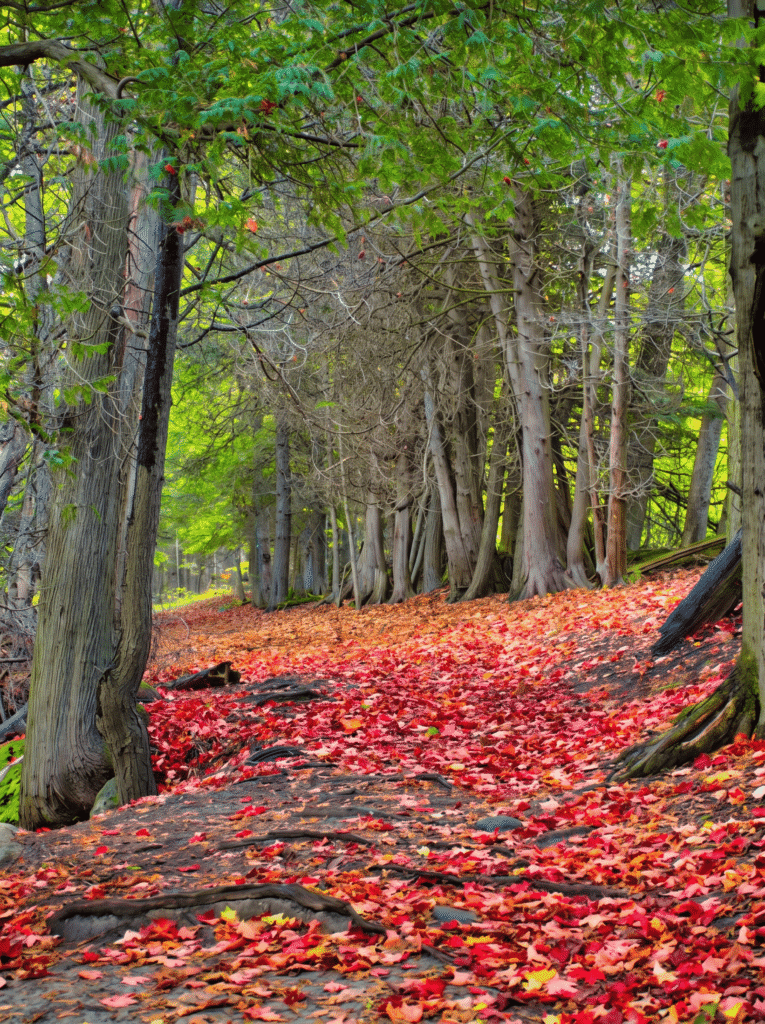
For the day when you mostly want to drive through fall, put Mono and Caledon together rather than choosing one pin on Google Maps.
Start around Mono Cliffs Provincial Park, where trails run through forest, cliffs and the Niagara Escarpment landscape. The park is beautiful in autumn but has limited capacity, and Ontario Parks requires visitors to obtain a daily vehicle permit in advance to guarantee access. Permits are released up to five days ahead, with timed four-hour slots as well as full-day options.
From there, make the drive south toward Forks of the Credit Provincial Park. Ontario Parks specifically points to the Trans Canada Trail as one of its best places for fall-colour viewing, and the surrounding Caledon roads are part of the experience — rolling countryside, forest and the occasional farm stand replacing the Gardiner for an afternoon. Forks of the Credit also uses advance vehicle permits to guarantee park access.
If you still have daylight, the general route puts you in a good position to stop elsewhere around Caledon before heading home. But don’t over-plan it. This is the trip where the drive between places is almost as good as arriving.
Also, book the parks before getting emotionally attached to the itinerary. Mono Cliffs and Forks of the Credit are exactly the kinds of places everyone remembers exist on the same perfect October Saturday.
Not every fall day needs hiking boots.
Niagara-on-the-Lake is our pick for the day when you want vineyards, lunch and a long walk through a pretty town instead. The historic district is built for wandering, with preserved architecture, boutiques and restaurants around Queen Street, while the surrounding wine country has more than 40 estates and small tasting rooms spread between Lake Ontario and the Niagara Escarpment.
Fall is especially good here because wine country changes with the season too. The vineyards turn, temperatures cool down and a tasting suddenly feels much more appealing than it did during a humid July afternoon. Choose one or two wineries rather than trying to speed-run six of them, then leave time for the old town and the waterfront.
The catch is the drive. Niagara is absolutely possible as a Toronto day trip, but weekend traffic can turn a pleasant journey into something much longer. Recent Toronto discussions include everything from roughly two hours to considerably worse depending on traffic, and locals generally recommend having a car if you want to explore wineries rather than only the main town.
So leave Toronto early. Have breakfast when you get there. Stay for the afternoon. And do not schedule a downtown dinner reservation for exactly two hours after you leave Niagara unless you enjoy unnecessary suspense.