TORONTO ELECTION 2026: WHAT YOU ACTUALLY NEED TO KNOW
Toronto is voting again on Monday, October 26, and this election has become considerably more interesting than it looked a few months ago. The mayoral race has tightened, affordability still feels like the city's favourite impossible problem, and a record 222,550 people have already voted early — almost twice as many as during advance voting in 2022.
If municipal politics normally loses you somewhere between property-tax percentages and a City Council livestream, fair. But this is the election that touches the Toronto you actually live in: your TTC ride, your rent, the construction on your street, bike lanes, parks, libraries and how much the city costs to run. So here's what is happening, without turning it into homework.
By CELESTE FERNER SEPTEMBER 21, 2026
SO, WHAT ARE WE ACTUALLY VOTING FOR?
Toronto has roughly 2.14 million eligible voters choosing a mayor, 25 city councillors and, where applicable, school board trustees. There are 361 certified candidates across all races, including an almost comical 53 candidates for mayor.
You won't see political parties beside the names. Everyone gets to vote for mayor, while your councillor and trustee candidates depend on where you live. And while the mayoral race gets most of the attention, don't ignore the councillor part: decisions around neighbourhood development, local streets, parks, services and plenty of the things that make you love — or complain about — your particular corner of Toronto happen at council.
The easiest way to see exactly what's on your ballot is the City's MyVote tool. Enter your address and you'll find your ward, candidates, assigned voting place and sample ballot. It's probably the most useful five minutes of election prep you can do.
Check your ballot with MyVote
THE MAYORAL RACE IS REALLY ABOUT TWO NAMES
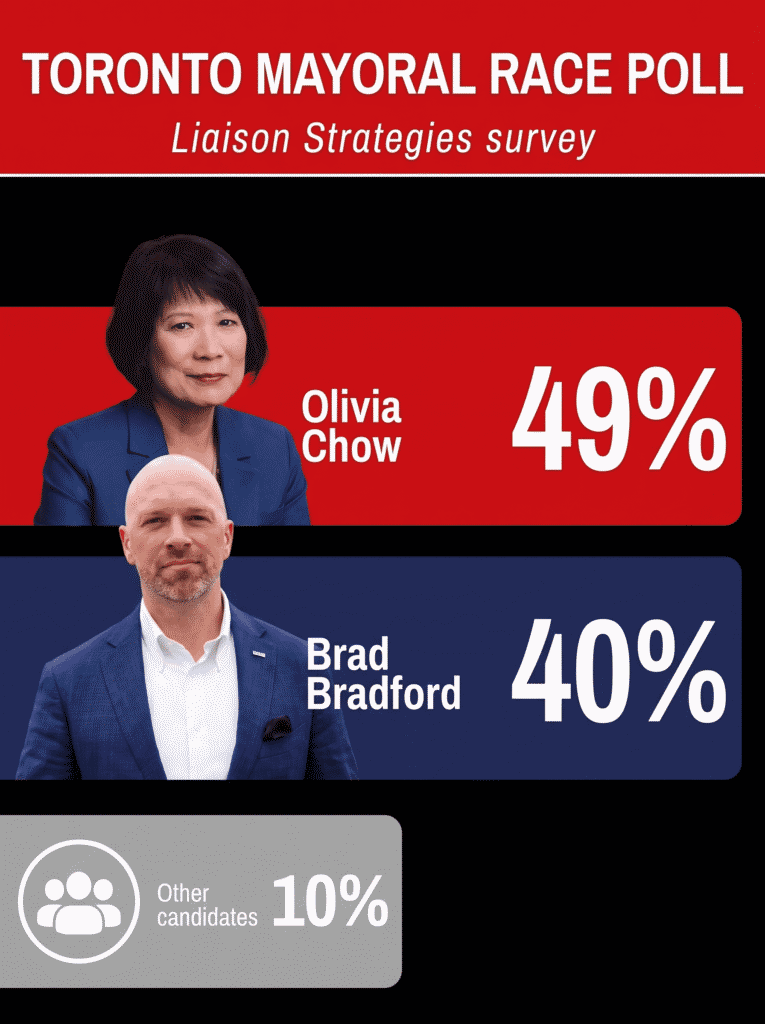
There may be 53 names on the ballot, but the mayoral race has effectively centred on incumbent mayor Olivia Chow and Beaches–East York councillor Brad Bradford. Former federal cabinet minister Chris Alexander had also been one of the higher-profile contenders before suspending his campaign after the deadline to have his name removed, which means voters will still see him on the ballot.
The choice between the two frontrunners isn't simply left versus right in some abstract political-science way. It's two fairly different ideas about how City Hall should respond to the very expensive, occasionally chaotic city we're all living in.
Chow's campaign puts more emphasis on using public programs and City resources to address affordability. That includes affordable housing, renter supports, school food and keeping TTC fares from rising. Bradford's platform focuses more on taxes, City spending, home ownership, public safety and housing supply. His proposals include freezing the property-tax rate in his first year. He also wants to remove Toronto's municipal land-transfer tax on the first $1.1 million of a principal-residence purchase.
And this isn't looking like a race where the outcome should simply be assumed. Recent polling has shown the gap narrowing as Election Day gets closer, making those record advance-voting numbers particularly interesting.
HOUSING, TTC, TAXES — THE VERY TORONTO PART
Strip away the lawn signs and debate clips and the issues driving this election are extremely familiar: housing, affordability, TTC, taxes, traffic and public safety. Basically, the group chat after someone mentions how much their landlord wants for a one-bedroom.
Housing is one of the clearest dividing points. Chow is campaigning on more affordable housing and stronger protections and enforcement for renters, while Bradford's affordability pitch puts more emphasis on increasing supply, lowering costs connected to home ownership and changing the City's approach to taxes and spending.
Taxes and safety are another divide. Chow has said property-tax increases would be capped at no more than one percentage point above inflation. Bradford has promised a property-tax rate freeze in his first year and proposed adding 1,000 police officers. Transit reliability, TTC safety, congestion and bike infrastructure have also repeatedly surfaced throughout the campaign.
You don't need to develop a passionate opinion on every page of every platform. Think about the version of Toronto you interact with every day. If rent is eating your paycheque, start with housing. For anyone whose commute depends on Line 1 behaving itself, the transit plans are worth a look. And if you're trying to buy a home here, compare what each candidate is actually proposing around taxes and housing costs.Municipal politics gets much easier to understand once you stop treating it as politics and start treating it as your neighbourhood.
CAN YOU ACTUALLY VOTE?
The basic eligibility rules are pretty straightforward. You need to be 18 or older, a Canadian citizen and a Toronto resident. Certain non-residents can also qualify through owning or renting property in Toronto, including through a spouse. Owning multiple Toronto properties does not turn this into a loyalty program — you still only get one vote.
If you missed the deadline to add yourself to the voters' list online, you haven't missed the election. Eligible voters can still have their name added at their assigned voting place on Election Day. You'll need acceptable identification showing your name and qualifying Toronto address.
And here's the useful part: photo ID isn't required. A driver's licence works, but the City accepts a much broader range of documents, including certain bank or credit-card statements, utility bills, leases and government documents showing your name and address. Your voter information card can make things easier, but it isn't identification and isn't required to vote. A passport alone isn't enough because it doesn't show your address.
If there's any doubt about what you're bringing, check the City's official list before leaving home rather than discovering the problem at the polling station.
See the City's accepted ID list
YOUR OCTOBER 26 PLAN
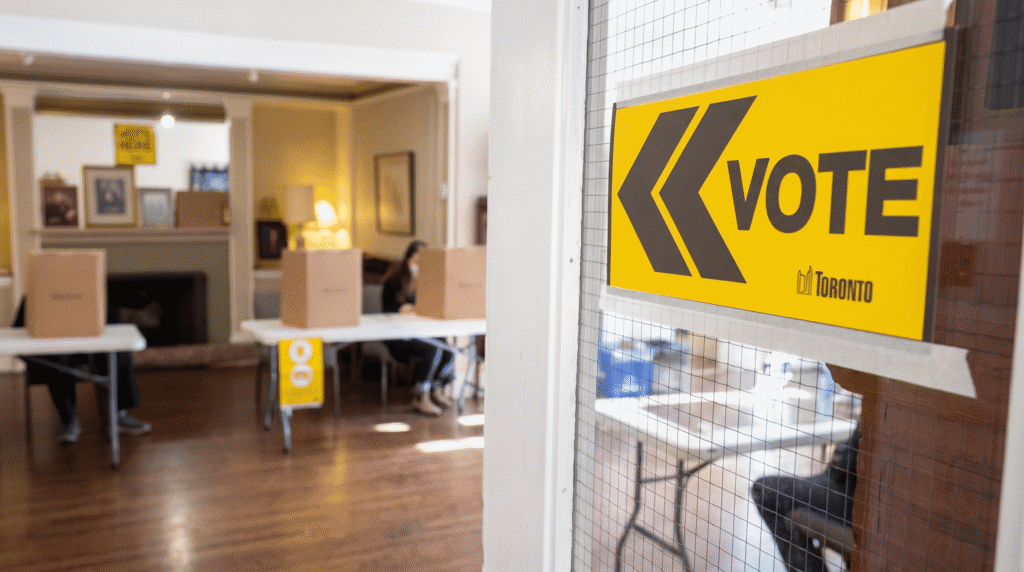
Election Day is Monday, October 26, with voting open from 10 a.m. until 8 p.m. Advance voting finished on October 11, so if you haven't voted already, this is the date that matters.
Before leaving home, check MyVote instead of wandering into the nearest school with election signs and hoping for the best. On Election Day, you have an assigned voting place based on your address, and the City recommends checking your location before you go because voting places can change. MyVote also gives you a sample ballot, which is particularly helpful when there are 53 mayoral candidates plus your local races.
If you genuinely can't vote yourself, you can appoint another eligible Toronto voter to vote for you. The City Clerk must certify the paperwork by 4:30 p.m. on Election Day.
And please don't spend an hour comparing mayoral platforms only to reach the councillor section and choose based on whose name you've seen on the most lawn signs. Look up your ward candidates before you go. The person representing your neighbourhood at City Hall can have a very direct relationship with what gets built, fixed, changed or funded around you.